Gate3 min read
Gate 50: The Gate of the Values
Gate 50, The Gate of the Values, is one of the 64 gates in Human Design. It sits in the Spleen Center and corresponds to I Ching hexagram 50.
Is Gate 50 in your chart?
Your free chart shows your type, authority, profile, centers, channels and gates in one picture.
- Center
- Channel partner
- I Ching hexagram
- Hexagram 50
- Circuit
- Tribal (Defense)
On this page
Overview
Gate 50 corresponds to Hexagram 50 of the I Ching, 'The Cauldron' — the place where life's principles cook and simmer. Nothing matters more to this gate than that the principles which preserve and support family, workplace, and community are embraced and respected.
Principles are often passed down through generations or absorbed at home, church, or school. But with this gate active, you are naturally attuned to what is suitable and what is not, what is just and what is unfair, in any situation at any moment. You recognize and honor the values and proper actions that, to your eye, lead to sustainable and efficient living. Some principles endure; some need replacing. Gate 50 is repeatedly called on to tune in to what a situation actually needs.
Your big questions are "What are the principles that are going to serve society best?" and "Can everyone be encouraged to be personally accountable?" They tie into an inherent fear of taking responsibility. Standing up for right and proper principles puts pressure on you to be an example in society, and you feel that weight keenly. The fear intensifies if your Spleen center is undefined, so lean on your authority for reassurance and guidance. Yet no one will be more outspoken than you when you sense that moral decline is endangering the common good or a secure future for the community.
Transit Meaning
When Gate 50 is activated by transit, it brings a collective focus on values, responsibility, and the rules that hold communities together. Many people feel a heightened awareness of what is right and wrong within their sphere of influence, along with a stronger sense of duty toward family. Conversations about laws, ethics, and social responsibility become more prominent.
This is a time to uphold your values and care for those who depend on you while staying open to updating rules that no longer serve the greater good. Use this window to examine which rules you follow out of genuine conviction and which ones you follow out of fear.
This Gate in Love & Relationships
You instinctively set the values and ground rules a shared life is built on, establishing the moral foundation of your household so that the principles you live by are just, sustainable, and respectful. Your partner quickly learns that certain standards are non-negotiable for you and that compromise on core values does not come easily.
Your instinct to care for and protect your loved ones runs deep, but so does a genuine fear of the weight that responsibility carries. You may hesitate to fully commit, knowing that stepping into the role of caretaker and moral guardian has real consequences. That pull between wanting to protect and fearing the burden of it can create internal conflict that affects your willingness to open up in love.
In partnership, you become the one who speaks up when something feels unjust or when the relationship is drifting from its founding principles. This makes you a stabilizing force, but it can also cause friction if your partner reads your moral stance as rigidity. Expressing your values as invitations rather than judgments keeps the warmth and connection your relationships need to thrive.
The most fulfilling partnerships for Gate 50 carriers are those where both people share a strong foundation of principles and hold each other accountable with love and respect. When your partner honors the same values you hold dear and helps build a principled home, the cauldron of your relationship nourishes everyone it touches. What you offer most in love is a safe, values-driven environment where your family can flourish.
Know when Gate 50 is active
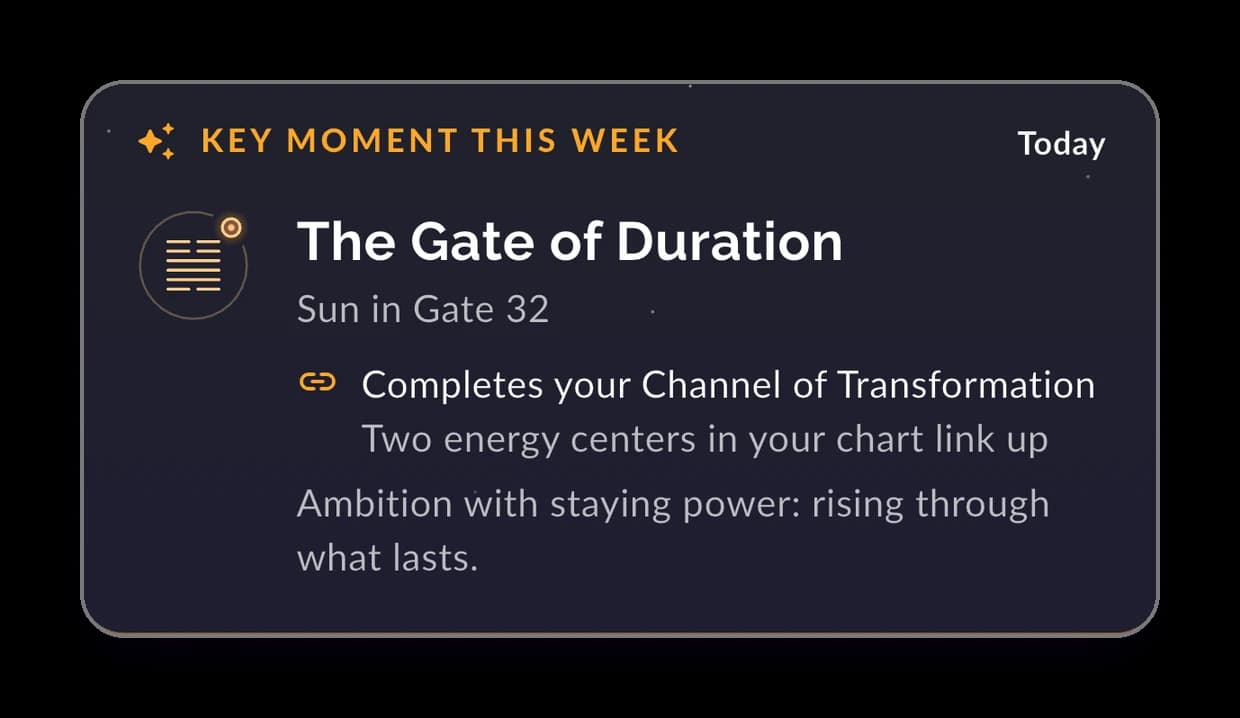
The planets move through the gates all year. Week Ahead in the app shows when one moves into a gate, and what it completes in your own chart.
Common questions
What role does Gate 50 play in family and community?
Gate 50 acts as the moral compass of the tribe, constantly tuning into which principles best serve the collective. You sense which values should endure and which need replacing based on what each situation calls for. No one will be more outspoken than you when you feel that moral decline is threatening the common good or the secure future of your family and community.
How are Gate 50 values formed and expressed?
Gate 50 values often begin as traditions passed down through family, religious institutions, or education, but your innate sense of justice keeps refining them. You ask which principles best serve society and whether personal accountability can be encouraged. This mix of inherited wisdom and present-moment awareness makes your moral guidance both grounded and adaptive.