Guide5 min read
How to read a Human Design chart
A Human Design chart is a lot of marks on a first look. The useful order is the order the free Soul Flow reading already uses.
Start with type and strategy. Then authority. Then profile. Then the BodyGraph: which centers are colored, which channels connect them, which gates are on. Only after that is it worth reading the two planetary columns and the incarnation cross.
You will need a chart in front of you. The free chart calculates one from birth date, time, and place, without an email. If the birth time is unknown, the result is marked approximate, because profile and some definitions can change with time. The steps below follow the result page, piece by piece.
See it in your chart
Read it on your own chart
Your free chart shows your type, strategy, authority, profile, centers, gates and channels, calculated from your exact birth time and place.
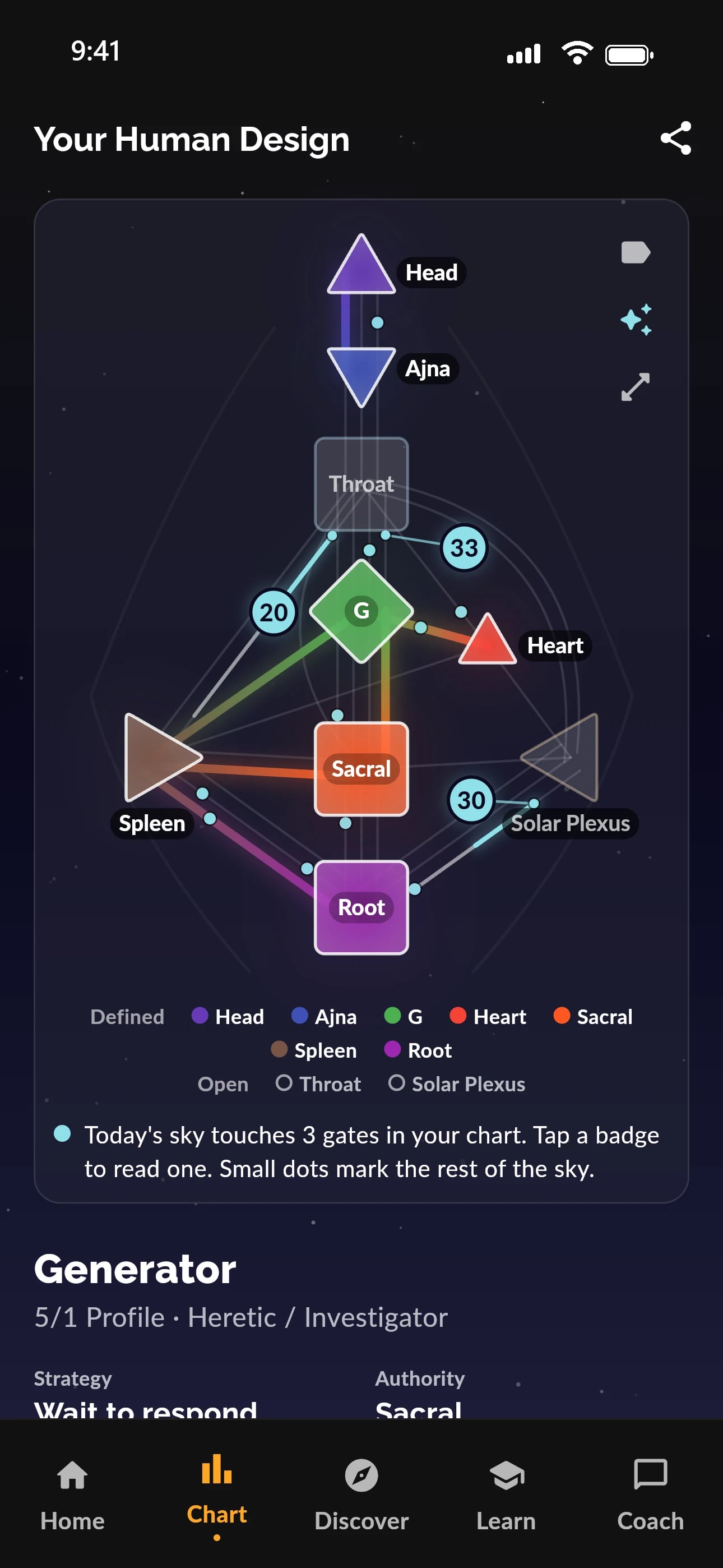
Type and strategy, first
Type is the headline. Generator, Manifesting Generator, Projector, Manifestor, or Reflector. It is determined by definition, not by vibes. Defined Sacral and no motor to the Throat: Generator. Defined Sacral plus a motor to the Throat: Manifesting Generator. Open Sacral, no motor to the Throat, at least one defined center: Projector. Motor to the Throat, open Sacral: Manifestor. All nine centers open: Reflector.
Strategy is printed with the type. Wait to respond. Respond, test, then inform. Wait for the invitation. Inform before acting. Wait a lunar cycle of about 28 days. Read about your type before you interpret a single gate. A gate in an open center does not override the strategy. The not-self theme (frustration, bitterness, anger, disappointment) is the signal that the strategy was skipped. The signature is the signal that it was not.
Authority, which is not strategy
The authority line is the decision mechanic. Emotional: no truth in the now, wait out the Solar Plexus wave. Sacral: gut response in the moment, only if the Sacral is defined and the Solar Plexus is not. Splenic: one quiet hit, in the present, that does not repeat. Ego: what you actually have the will to back. Self-Projected: talk it out and listen for what sounds like you. Outer, or no inner authority: Mental for a Projector with nothing defined below the Throat, who talks it through with trusted people in the right place, and Lunar for a Reflector, who waits out a lunar cycle.
If you are a Generator with Emotional authority, you still wait to respond, and you do not treat the first Sacral sound as the final yes. That distinction has its own page: Emotional vs Sacral. The long version of each authority is in the authorities hub.
Profile: two lines
Profile looks like 1/3, 4/6, or 5/1. Twelve combinations, no more. The first number is the conscious Personality line, the part of the role you can see in yourself. The second number is the unconscious Design line, the part other people often see first. Each pair has its own page in the profiles hub.
Profile also sets the angle of the incarnation cross. Right Angle profiles are 1/3, 1/4, 2/4, 2/5, 3/5, 3/6, and 4/6. The 4/1 is the Juxtaposition profile. Left Angle profiles are 5/1, 5/2, 6/2, and 6/3. You do not need to memorize that to read the chart. The result page shows the angle next to the cross’s four gates. How those four gates are chosen is in the incarnation cross guide.
Centers, channels, and gates
Colored centers are defined. Uncolored centers are open. Read a defined center as consistent energy you radiate. Read an open center as a place you take other people in, and where you are easiest to condition. The nine, with their own pages: Head, Ajna, Throat, G, Heart, Sacral, Solar Plexus, Spleen, and Root. Definition, also printed on the chart, tells you whether those defined centers are one connected circuit (Single) or two, three, or four separate areas (Split, Triple Split, Quadruple Split). No Definition means Reflector.
A channel is two gates and the line between two centers. If the channel is defined, both centers are defined. There are 36 channels, listed in the channels hub. Gates are the 64 hexagrams. The result highlights the ones activated in your chart. Start with the gates that complete a channel. A hanging gate, active on one side only, is a theme you carry that is completed by someone else. Use the gates hub as a reference, not as the first thing to memorize.
Black column, red column, and what the arrows are not
The Detailed view of the BodyGraph has two lists of planets. Personality, the conscious side, is the black column on a printed chart and the white one here: traits you tend to recognize. Design, the unconscious side, is the red column: body-level traits other people often notice sooner than you do. Each planet is shown as gate.line, for example 13.4. Sun is at the top of each column. Earth is next. Those four activations (Personality Sun, Personality Earth, Design Sun, Design Earth) are the incarnation cross.
Many charts elsewhere draw four arrows beside those columns. Those arrows are the variables, a layer under the line. The free Soul Flow reading does not draw them. It shows gate and line. If you came here to decode arrows, read what the arrows mean and notice exactly which part the Soul Flow chart prints. Then come back to type, authority, and the centers. That is the reading that changes a Tuesday.
Questions
Common questions
What should I read first on my chart?
Type, then strategy, then authority, then profile. Centers come next: colored is defined, uncolored is open. Channels and gates are the detail. The incarnation cross is the life theme from the Sun and Earth gates, and it makes more sense after the type is clear.
What is the difference between the black and red sides?
Black is Personality, the conscious side, what you tend to identify with; the Soul Flow chart shows it in white. Red is Design, the unconscious side, traits that are more bodily and often more obvious to other people. Both are part of one chart. The Detailed view lists each as gate.line.
What if I do not know my birth time?
You can still generate a chart. It is approximate. Profile and some defined channels are the pieces most sensitive to time. Use a birth certificate time when you can get one. Do not invent noon and treat it as exact.
Does a defined center mean that part of life is good?
No. Defined means consistent. Open means you experience that theme through other people, with less of a fixed way of your own. Both are part of the design.
See it in your chart
Your free chart shows where this sits in your own design, from your exact birth time and place.
Calculate your free chart